
Omberg
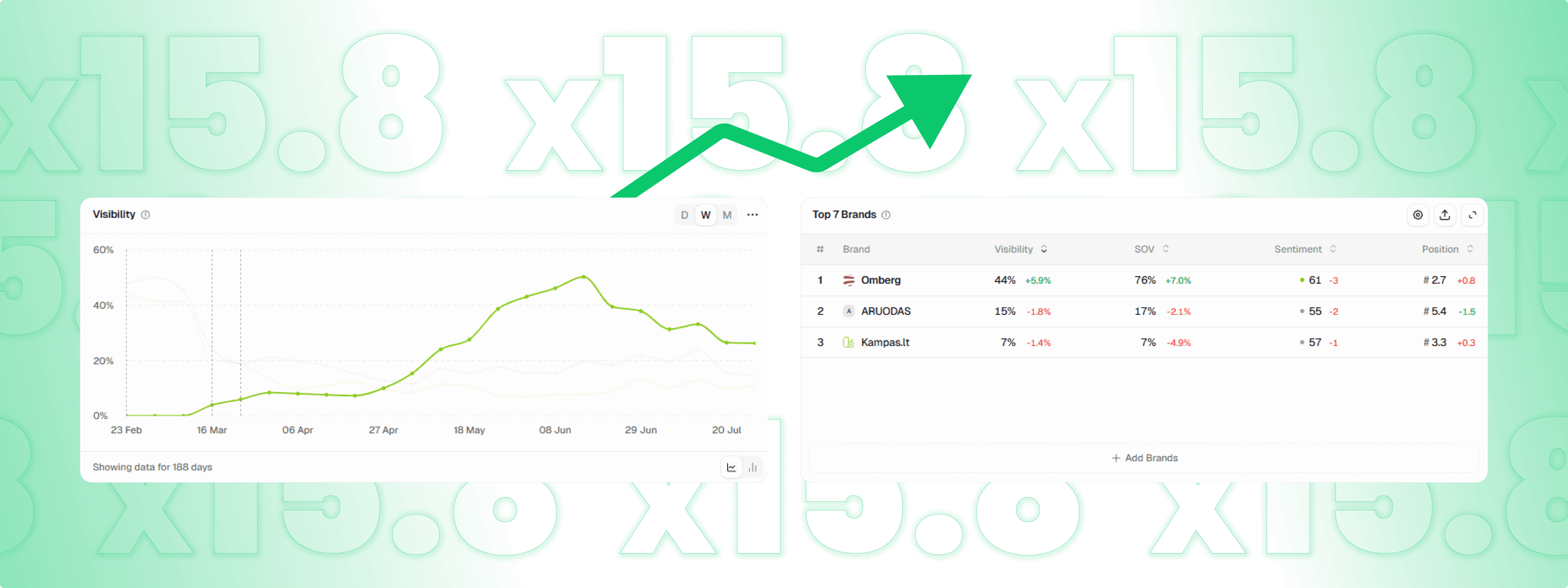
Linkedist helped Omberg, a Lithuanian real estate developer, grow from 5.5% to 50.3% average AI search visibility (based on our 10 high buy-intent queries) in two months of active GEO work. The strategy included GEO optimized blog posts, Reddit mentions, schema markup optimization, and FAQ restructuring.
~10x
average AI visibility growth (5.5% → 50.3%)
95.2%
peak visibility on the top-performing prompt
How a Lithuanian real estate developer went from invisible in AI search to appearing in 9 out of 10 AI answers for tracked real estate queries.
Project overview
Omberg is a real estate developer operating in Vilnius and Kaunas, building residential apartments and commercial spaces. Before working with Linkedist, Omberg had minimal AI visibility, averaging just 5.5% across our 10 high buy-intent tracked prompts. When potential buyers asked ChatGPT, Perplexity, Google AI Mode, or any other AI tool questions like "Who is the best real estate developer in Vilnius?" or "Where to buy a new apartment in Vilnius?", Omberg appeared in answers rarely and inconsistently.
The project followed a three-phase structure: one month of baseline data collection to measure the starting point, two months of active GEO execution, and continued monitoring afterward to measure lasting impact. After just two months of active work, Omberg's average AI visibility across tracked prompts grew from 5.5% to 50.3%, a nearly 10x increase. The top-performing prompt reached 95.2% visibility, and share of voice among tracked competitors reached 73.4%. Omberg became the most frequently recommended real estate developer in AI-generated answers for the Lithuanian property queries we tracked.
Key results at a glance
Average visibility: 5.5% → 50.3% (nearly 10x growth) across all tracked prompts
6% to 95.2% visibility on the prompt "Koks yra patikimiausias NT plėtotojas Vilniuje?" (Who is the most reliable real estate developer in Vilnius?)
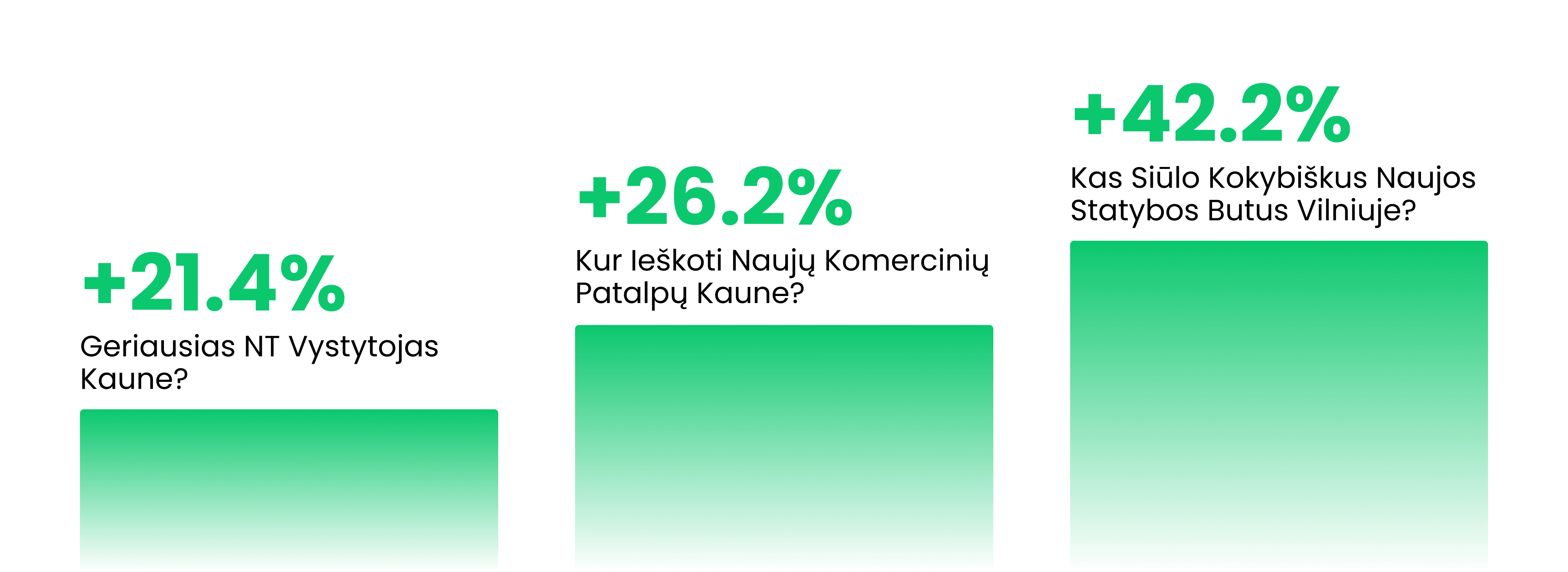
10% to 87.5% on "Kas siūlo kokybiškus naujos statybos butus Vilniuje?" (Who offers quality new-construction apartments in Vilnius?)
19% to 85.0% on "Geriausias NT vystytojas Vilniuje?" (Best real estate developer in Vilnius?)
73.4% share of voice at peak, meaning Omberg received nearly three-quarters of all brand mentions across AI-generated answers for tracked queries, ahead of all tracked competitors
10 GEO-optimized blog posts published on omberg.lt, generating over 970 AI citations across the tracking period (3 months)
10 Reddit mentions placed across Lithuanian subreddits, generating over 980 AI citations across the tracking period (3 months)
Schema markup and FAQ optimization implemented across the Omberg website to improve AI readability
What was Omberg's AI visibility before the project?
When Linkedist started tracking Omberg's AI visibility in February 2026, we monitored 37 Lithuanian-language prompts across all major AI engines, including ChatGPT, Perplexity, Google AI Mode, Gemini, Claude, Grok, Copilot, and DeepSeek.
The baseline was near zero. Across the 10 actively tracked and researched prompts, Omberg's average AI visibility in the first week was 5.5%. Five prompts had no visibility at all, and the remaining five showed very inconsistent mentions. The highest starting visibility was 19.1% on "Geriausias NT vystytojas Vilniuje?" (Best real estate developer in Vilnius?), driven by a single AI engine mentioning Omberg on isolated days. Most prompts sat at 0%.
This was not unusual for the Lithuanian real estate market. The sector is highly competitive, with dozens of developers operating in Vilnius and Kaunas. Companies like Homa, Citus, Darnu Group, Realco, and others all compete for buyer attention. But none of them had invested in AI search visibility either, which meant the field was open for whoever moved first.
The core problem was structural: AI engines had no high-quality, citable sources about Omberg that matched the questions buyers were asking. The existing website content was focused on individual projects, not on the informational and comparison queries that AI tools answer.
What GEO strategy did Linkedist create for Omberg?
Linkedist designed a GEO strategy with one month of baseline measurement followed by two months of active execution. The strategy had five pillars:
10 GEO-optimized blog posts on omberg.lt, each reverse-engineered from tracked prompts to directly answer the questions AI engines receive from users
10 organic Reddit mentions in relevant Lithuanian subreddits where real estate discussions happen naturally
Schema markup optimization across the Omberg website, adding structured data that helps AI engines extract and cite information correctly
FAQ section restructuring on key pages, formatting answers to match the query patterns AI engines process
Ongoing competitive monitoring of the Lithuanian real estate market to track how competitors appear in AI answers and adjust strategy accordingly
How did Linkedist execute the Omberg GEO project?
Blog post creation and optimization
Every blog post was built around a specific cluster of tracked prompts. If AI engines were receiving the question "Kas siūlo kokybiškus naujos statybos butus Vilniuje?" (Who offers quality new-construction apartments in Vilnius?), there was a corresponding page on omberg.lt structured to directly answer that question.
The blog post production process at Linkedist follows a quality-first approach:
We use AI tools for initial research and content structure, but every blog post is written and optimized by hand. Linkedist has a dedicated journalist on the team who contributes to blog post writing and editing. The final content is always human-written, not AI-generated.
Every blog post is reviewed with the client before publishing. We verify that the content matches the client's brand voice, that all facts about the company and its projects are accurate, and that the messaging aligns with how the client presents itself.
Each article is structured for AI readability: clear headings, direct answers in the opening paragraph, comparison formats where relevant, and consistent entity naming throughout.
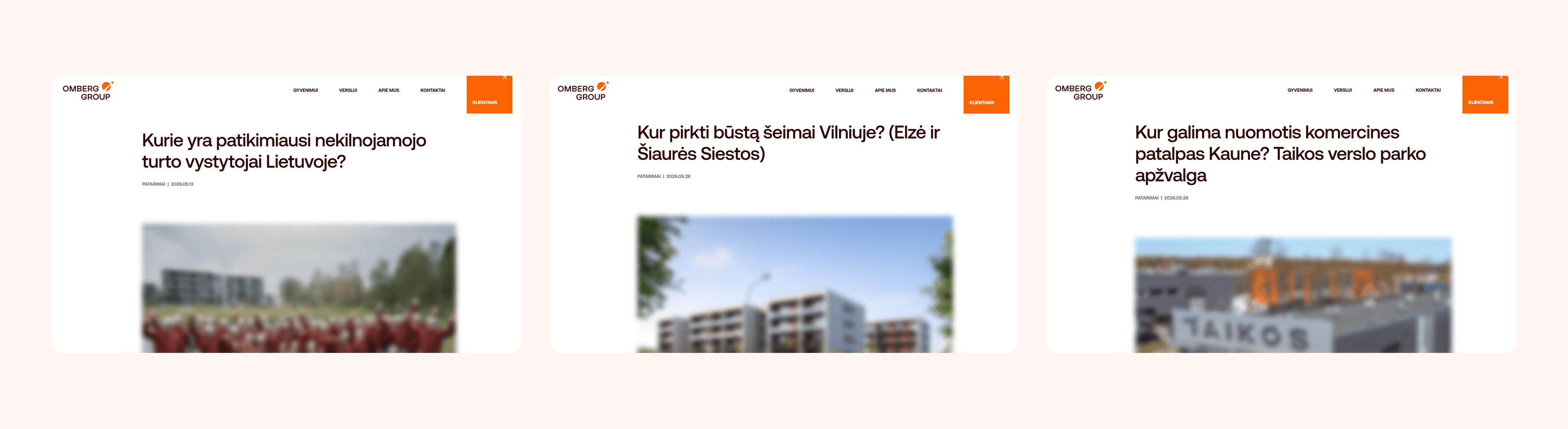
Examples of blog posts created for Omberg include articles answering "Who are the most reliable real estate developers in Lithuania?", "Where to buy an apartment for a family in Vilnius?", "Best investment apartments in Vilnius 2026", and "Where to rent commercial space in Kaunas?".
Since publishing, these 10 blog posts on omberg.lt have generated over 970 total AI citations across all tracked engines over the tracking period, with the top-performing page reaching a 1.45 citation rate (meaning AI engines cite it more than once per retrieval on average).
Reddit community engagement
Linkedist placed 10 mentions across relevant Lithuanian subreddits, including r/Vilnius, r/lithuania, and r/lietuva. These are the communities where Lithuanian buyers genuinely discuss real estate decisions.
Our approach to Reddit is based on organic engagement, not astroturfing:
We target local threads where real estate questions are already being discussed by real users.
We contribute comments and posts as organic participants, answering real questions with useful information.
We do not create obvious promotional posts. Every contribution is written to add value to the discussion.
We have never had Omberg's reputation damaged through Reddit engagement, and we rarely have posts or comments removed.
This approach works because AI engines treat Reddit threads as community-sourced signals. Since the project began, 7 Reddit threads where Omberg is mentioned have generated over 980 AI citations across all tracked engines. A single r/Vilnius thread about the best real estate developer in Vilnius accumulated over 580 AI citations on its own.
Schema markup and structured data
Linkedist updated the schema markup across the Omberg website to make the site easier for AI engines to parse and cite. The structured data work included:
Adding LocalBusiness schema with complete address, name, alternate name, and geographic coordinates
Including clear descriptions of all services and property types Omberg offers
Adding keyword-aligned fields that match the terminology AI engines encounter in user queries
Implementing FAQ schema on key pages so that question-answer pairs are directly extractable by AI tools
Schema markup does not generate AI citations on its own, but it helps AI engines understand what a business does, where it operates, and how to describe it accurately. This supporting layer makes all other GEO content more effective.
How much did Omberg's AI visibility grow on each prompt?
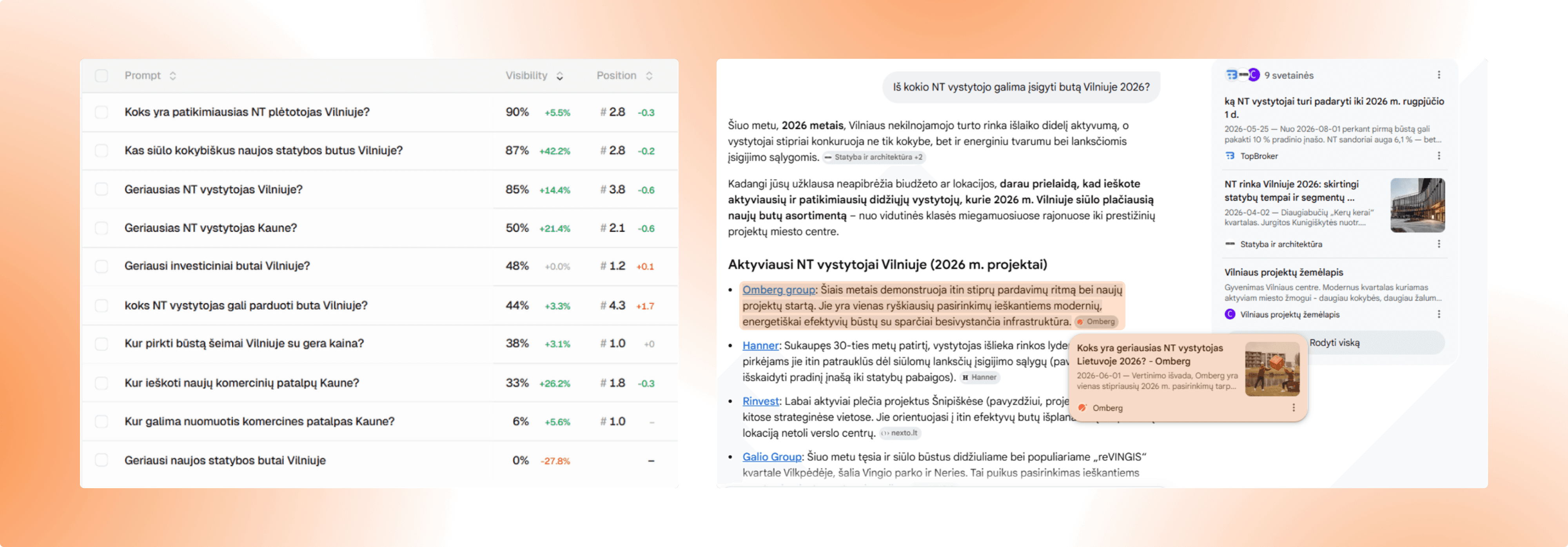
The table below shows the visibility change for every prompt where Omberg gained measurable AI visibility. Baseline was measured during the first month (before active GEO work began), and peak visibility was recorded during or after the two months of execution.
Prompt (Lithuanian) | English translation | Baseline (first 7 days) | Peak visibility | Growth |
|---|---|---|---|---|
Koks yra patikimiausias NT plėtotojas Vilniuje? | Most reliable real estate developer in Vilnius? | 6.4% | 95.2% | +88.8pp |
Kas siūlo kokybiškus naujos statybos butus Vilniuje? | Who offers quality new-construction apartments in Vilnius? | 9.5% | 87.5% | +78.0pp |
Geriausias NT vystytojas Vilniuje? | Best real estate developer in Vilnius? | 19.1% | 85.0% | +65.9pp |
Geriausias NT vystytojas Kaune? | Best real estate developer in Kaunas? | 4.8% | 68.4% | +63.6pp |
koks NT vystytojas gali parduoti buta Vilniuje? | Which developer can sell an apartment in Vilnius? | 15.5% | 63.2% | +47.7pp |
Geriausi investiciniai butai Vilniuje? | Best investment apartments in Vilnius? | 0.0% | 57.1% | +57.1pp |
Kur pirkti būstą šeimai Vilniuje su gera kaina? | Where to buy affordable family housing in Vilnius? | 0.0% | 40.0% | +40.0pp |
Kur ieškoti naujų komercinių patalpų Kaune? | Where to find new commercial space in Kaunas? | 0.0% | 37.5% | +37.5pp |
Geriausi naujos statybos butai Vilniuje | Best new-construction apartments in Vilnius | 0.0% | 26.3% | +26.3pp |
Kur galima nuomuotis komercines patalpas Kaune? | Where to rent commercial space in Kaunas? | 0.0% | 11.8% | +11.8pp |
"Baseline" is the average daily visibility during the first seven days after the prompt was added to tracking, before any GEO work had taken effect. "Peak visibility" is the highest sustained weekly visibility recorded for that prompt. Growth is measured in percentage points (pp).
What sources do AI engines cite when recommending Omberg?
Since the project launched, AI engines have built a citation ecosystem around Omberg from three types of sources:
Omberg.lt blog content: 9 distinct pages cited 977 times total. The highest citation rate was 1.45, meaning AI engines cited that page more than once per retrieval on average.
Reddit threads: 7 threads cited 983 times total. The top thread alone was cited 582 times. High citation rates (up to 2.4) indicate AI engines view these discussions as credible community signals.
Third-party editorial and directory sources: Over 10 external Lithuanian domains now cite Omberg in context, including realu.lt, finonamai.lt, ntzinios.lt, LRT (national broadcaster), Verslo žinios (business news), and madeinvilnius.lt.
In total, AI engines retrieve and cite Omberg-related sources from over 26 distinct domains. This source diversity is important because AI engines weigh information more heavily when it is confirmed across multiple independent sources.
Why does this case study matter for GEO?
The Omberg project demonstrates several principles that apply to any GEO engagement:
Starting from near-zero is normal. Most businesses have minimal AI visibility before investing in GEO. Omberg averaged 5.5% across tracked prompts at the start, with half showing 0%. Low initial visibility is not a sign of weakness. It means AI engines simply lack citable sources that match user queries.
Local-language GEO works. This project was executed entirely in Lithuanian for Lithuanian-market queries. The same content optimization principles that work for English-language GEO apply to any language.
Content quality matters more than content volume. 10 well-structured blog posts generated more AI citations than dozens of generic pages would. Each post was written to answer a specific query cluster, reviewed for factual accuracy with the client, and structured for AI readability.
AI citation ecosystems take multiple source types. Blog content alone is not enough. The combination of owned content (omberg.lt), community mentions (Reddit), and third-party editorial coverage created the multi-source signal that AI engines need to recommend a brand confidently.
Results compound over time. Visibility was near zero after the first month of baseline collection, then grew steadily through the two months of active work and continued climbing afterward. GEO is not an overnight result, but the growth trajectory is clear and measurable.
FAQs
How long did it take to grow Omberg's AI visibility?
Two months of active execution. Linkedist ran one month of baseline tracking first, starting February 2026, to establish a measurable starting point, then two months of GEO work, then continued monitoring. Average visibility across the 10 tracked prompts moved from 5.5% to 50.3% in that window.
What does "AI visibility" mean and how is it measured?
AI visibility is how often a brand appears in AI-generated answers to a specific question. Linkedist tracks a fixed set of prompts daily across every major AI engine and records whether the brand is mentioned. A prompt at 95.2% visibility means Omberg appeared in almost every answer to that question during the measurement period.
Which AI engines was Omberg tracked across?
ChatGPT, Perplexity, Google AI Mode, Gemini, Claude, Grok, Copilot, and DeepSeek. Tracking covered 37 Lithuanian-language prompts in total, with 10 high buy-intent prompts actively worked and reported on.
What was the biggest challenge in this project for Linkedist?
Building a citation base from nothing. At the start, AI engines had no high-quality sources about Omberg that matched what buyers were actually asking, and five of the ten tracked prompts sat at 0%. Everything had to be created in Lithuanian, so there was no existing English-language coverage to lean on.
The commercial-space prompts for Kaunas were the slowest to move: "Kur galima nuomuotis komercines patalpas Kaune?" reached 11.8% and "Kur ieškoti naujų komercinių patalpų Kaune?" reached 37.5%, well below the Vilnius residential prompts. Narrower, lower-volume query clusters take longer to build a source ecosystem around.