What happened when we handed our Instagram to Vilnius’ favourite meme lord soy.vilnius
Learn how humour, creator partnerships and cultural relevance helped turn a meme collaboration into evergreen content.

Miglė Vaitulionytė
Project Manager
There are several sensible things a LinkedIn marketing agency can do to build brand awareness.
Handing its Instagram over to a meme creator is perhaps not the most obvious one.
We did it anyway.
In the beginning of the summer, Linkedist collaborated with @soy.vilnius, one of Vilnius’ best-known meme creators, for an Instagram takeover. The idea was simple: while our social media manager was "on holiday", soy.vilnius would step in and fill our company Instagram with his memes.
No polished corporate campaign, no elaborate brand narrative and no attempt to force Linkedist into every punchline.
Just highly relatable internet humour appearing somewhere people probably did not expect it. Which was precisely the point.
The collaboration gave us a useful reminder about social media marketing: sometimes the content with the longest life is the content that asks the least from the audience.
First, who is soy.vilnius?
soy.vilnius has built a large audience by turning contemporary Vilnius life into hyper-specific satire.
His memes cover everything from fashion and niche trends to work, dating, consumer habits, neighbourhood stereotypes and the recognisable characters who inhabit them. Naujamiestis, Antakalnis and other parts of the city become personalities of their own, while matcha, natural wine, clothes, cafés and corporate life become shorthand for the people consuming them.
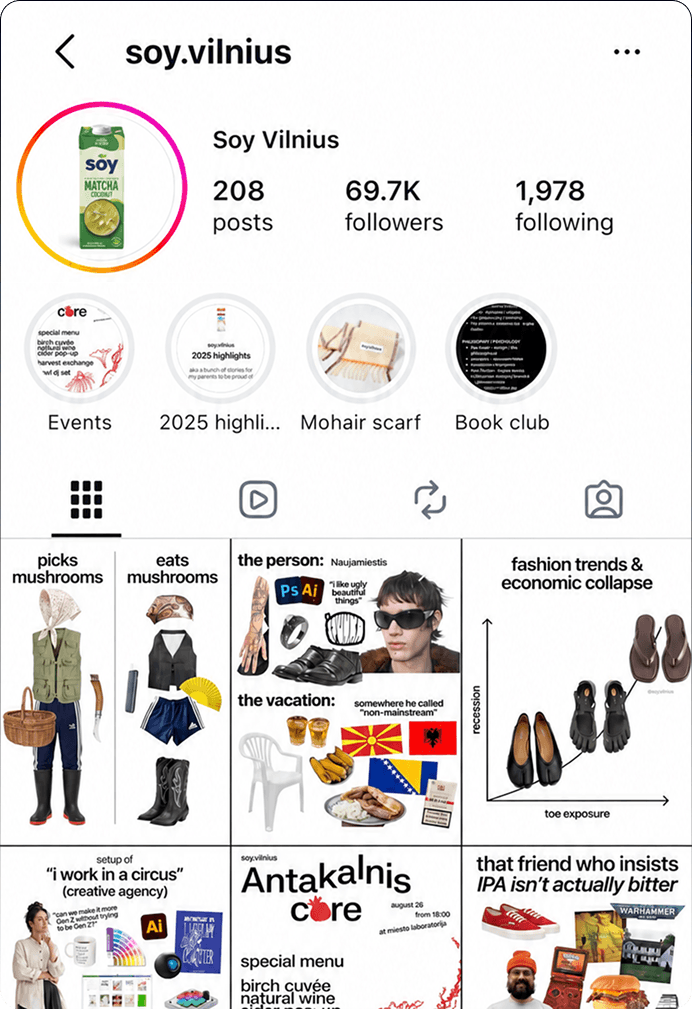
The humour works because it is observant rather than random. It takes small details of city life and exaggerates them just enough for people to recognise themselves, their friends or, perhaps more comfortably, someone else.
That made the collaboration especially interesting for us.
His audience extends far beyond the corporate bubble, but there is plenty of overlap with ours: young professionals, creatives, marketers and digitally native Vilnius residents who understand both the LinkedIn jokes and the wider cultural references.
Our aim was not simply to borrow the audience of a popular Instagram account, we were bringing a recognisable piece of Vilnius internet culture into Linkedist’s channels.
We wanted awareness, not another corporate campaign
The objective behind the collaboration was primarily brand awareness. Instead of asking soy.vilnius to completely adapt to our tone of voice, we wanted the opposite.
We wanted Linkedist to enter his world.
The takeover gave our own channels something intentionally different from the usual marketing content. It introduced satire without making the brand cynical and humour without turning the company into an account desperately trying to speak “internet”.
There is a difference.
Good branded humour feels like the brand understands the joke and bad branded humour feels like somebody forwarded the marketing team a screenshot of a meme and wrote: "Can we do something like this?"
Naturally, we were aiming for the first one.
LinkedIn, unsurprisingly, is at the centre of what we do. But that does not mean everything Linkedist publishes needs to look, sound and feel corporate.
We wanted to bring some entertainment into our communication, poke fun at the realities of professional life and make our brand feel more human without making the joke at anyone’s expense.
Proof that humour drives attention
Across the takeover week, the Instagram content generated:
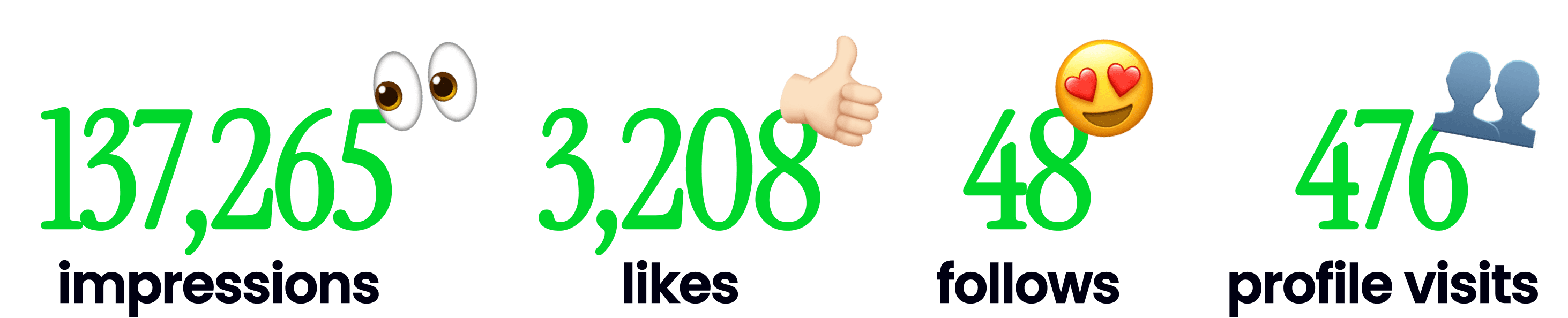
The strongest individual takeover post reached 102,244 impressions, generated 2,685 likes and resulted in 35 follows and 239 profile visits.
Another carousel generated 18,948 impressions and 332 likes, while the first carousel of the week brought in 15,757 impressions and 166 likes.
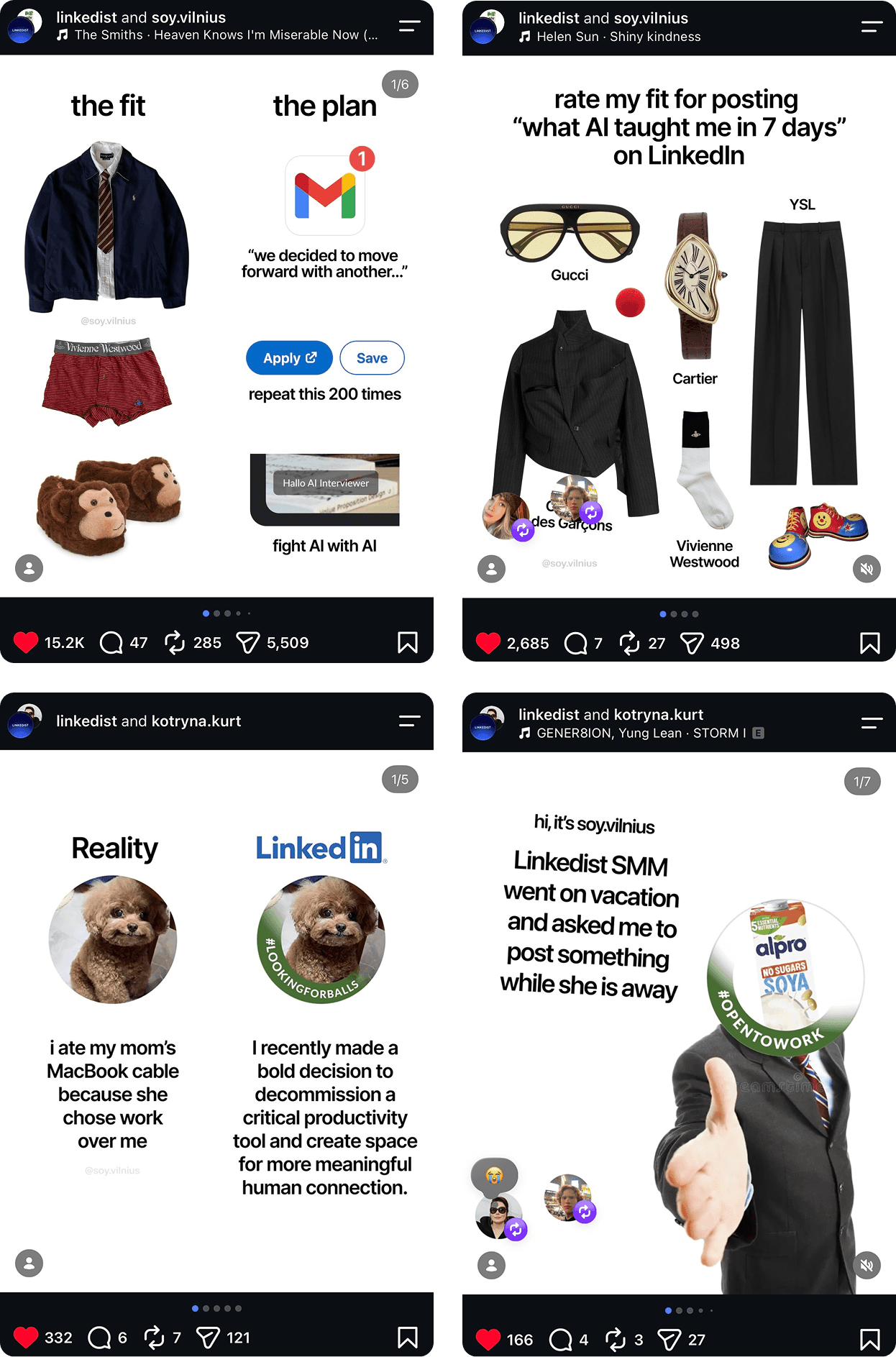
Not every format performed equally, revealing which content drove the strongest results.
The Instagram Stories produced considerably smaller numbers than the main feed posts. The feed carousels did the heavy lifting.
That makes sense, cause stories are temporary by design.
A good meme post can keep resurfacing. Just like ours did.
Then the collaboration became bigger than the takeover
The takeover itself was only one part of the experiment.
Around the same time, soy.vilnius published a May 1st post around work culture, job applications, LinkedIn and the realities of modern professional life, in which we were tagged and Linkedist was naturally placed into the conversation.
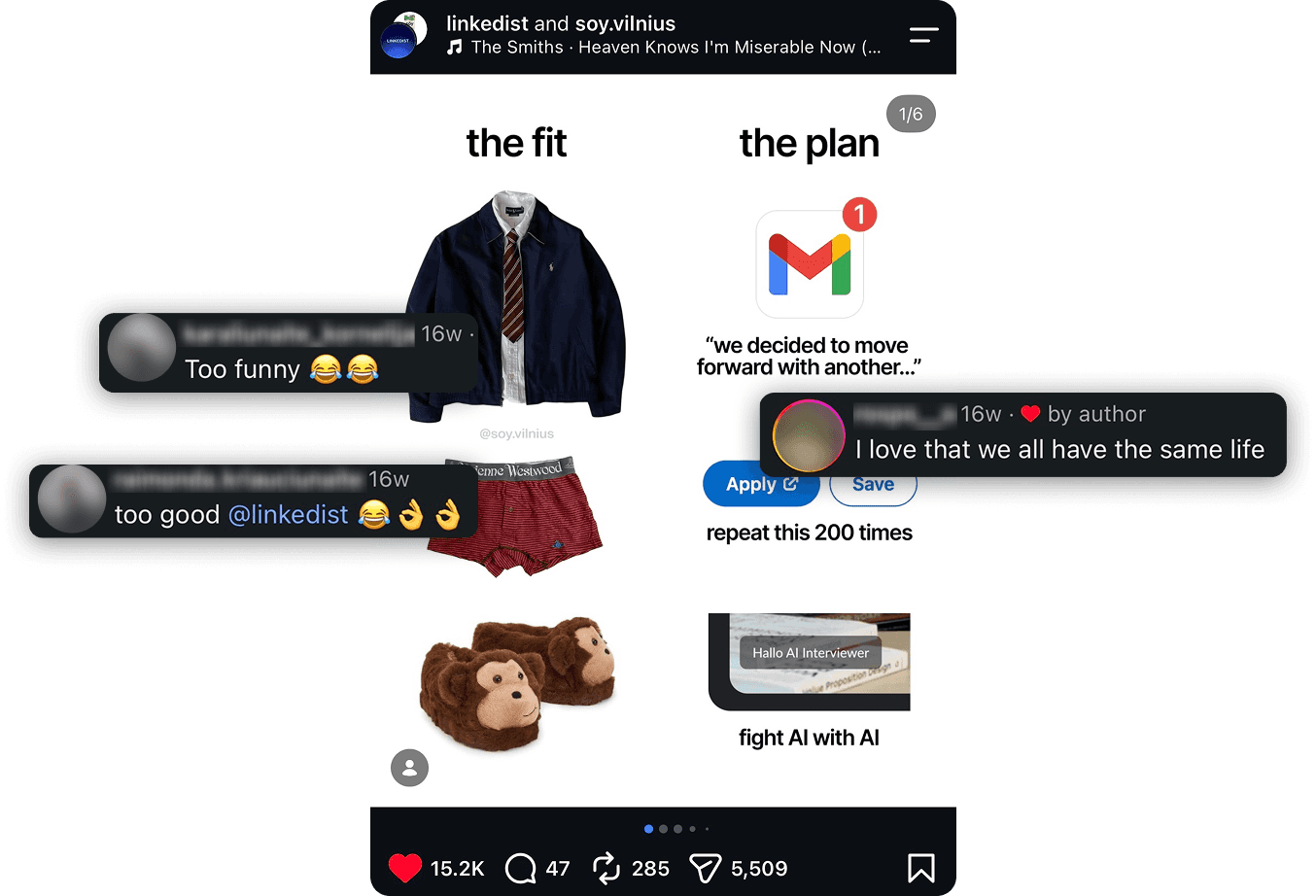
After a week, we asked to join it as an Instagram collaborator, which gave the content another route into our own audience while giving Linkedist visibility among his.
The post went significantly further than anything published during the takeover itself.
It recorded approximately:
245,000+ views
238,954 accounts reached
15,000+ likes
2,000+ saves
300 reposts
People called the post "too funny", "so relatable" and joked that everyone apparently lives the same professional life.
Others added their own versions of the joke. One commenter wrote that modern job listings seem to fall into two categories: retail jobs or roles requiring an impossible combination of technical skills and language fluency.
The strongest social content does not merely collect reactions, but it gives people enough cultural material to continue the joke themselves.
The audience was not being asked to admire a campaign. They recognised themselves or someone they know in it.
LinkedIn joined the entertainment too
We also decided to bring the collaboration onto the platform we know best.
On May 1st, we announced on LinkedIn that our social media manager was taking a break and that the following week we would be handing Instagram to someone who "definitely should (not) have it".
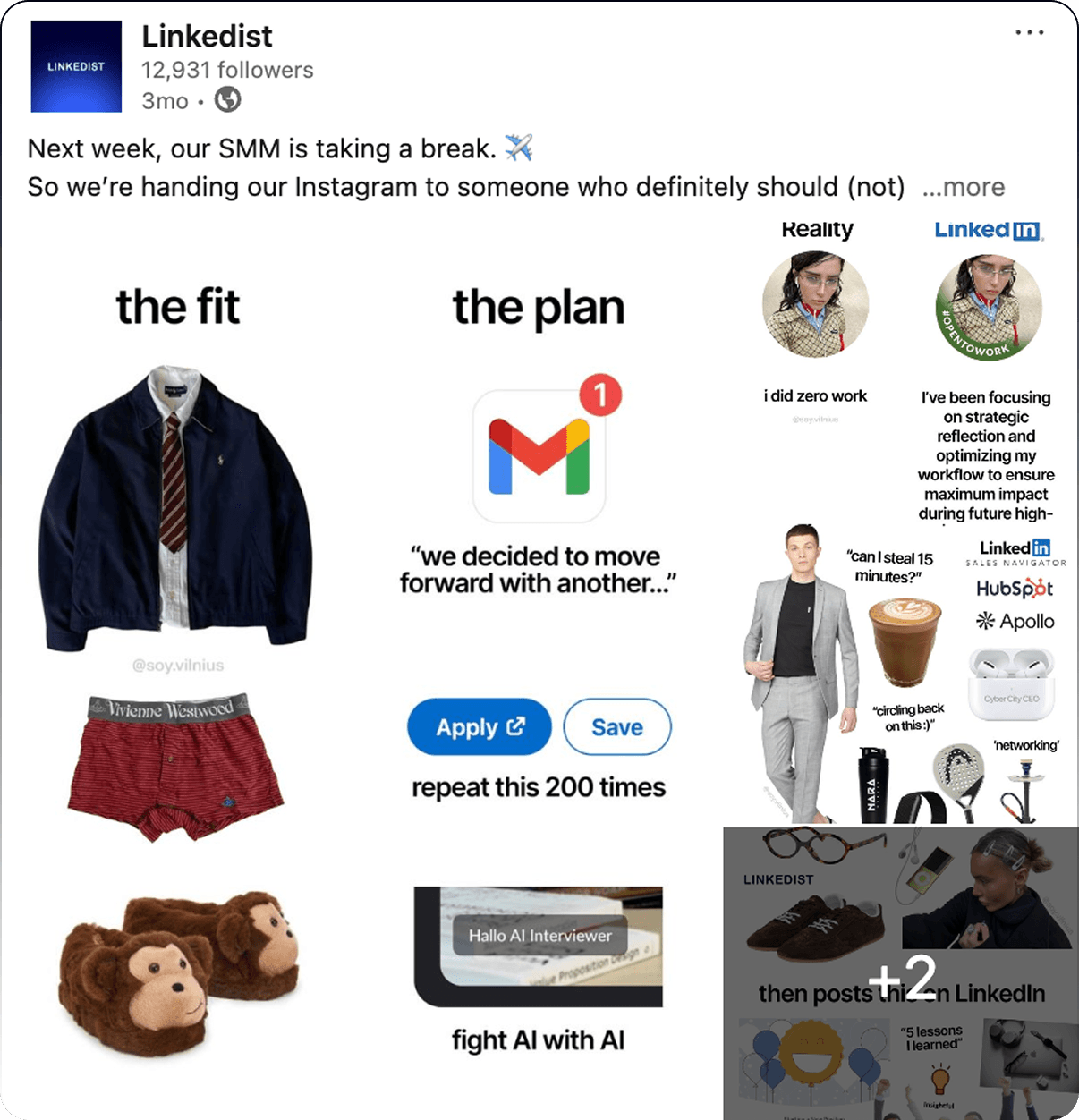
The post generated:
2,610 impressions
844 platform-recorded engagements
812 clicks
31 reactions
LinkedIn reported an engagement rate of 32.34% and a click-through rate of 31.11%.
For a company page announcement, the result told us that people were curious.
The post did not explain a service, announce an award or provide another seven-step marketing framework, it created anticipation around something unexpected.
And unexpected is a useful asset on a platform where people have already seen their fair share of "We are thrilled to announce..." posts before breakfast.
The most interesting result came months later
The most useful lesson from the collaboration was not necessarily the initial spike, but what happened afterwards.
The posts kept receiving likes in May, then June, then July, and even into August, with engagement still coming in on 18 August, more than three months after the original collaboration had gone live.
That gives us an interesting way to think about memes: they can function as evergreen social content.
When marketers talk about evergreen content, they usually mean educational articles, guides, SEO pages or posts answering a question people will continue searching for.
Yet entertainment can be evergreen too. A meme does not necessarily expire because the publishing date has passed.
If the underlying observation remains true, someone discovering it three months later can have exactly the same reaction as somebody seeing it on day one.
The algorithm might resurface it. Someone might repost it. A new follower might scroll backwards through the account. A collaborator’s audience might discover it later.
Or somebody might send it to a friend or colleague accompanied by perhaps the most powerful piece of social media copy ever invented: "us."
And suddenly the content has another life.
Memes have unusually low consumption friction
There is another reason this type of content travels: memes are extremely easy to consume.
You do not need three minutes, headphones, or even an understanding of a company’s product offering – just a few seconds and enough shared cultural context to get the joke.
That simplicity makes them naturally compatible with how people browse social media, and unlike much branded content, they often give people a reason to share without explicitly asking them to.
People rarely send their colleague a corporate thought-leadership graphic with the message: "This is literally us."
A meme has a much better chance.
That distinction matters because social distribution goes far beyond visible likes and comments. Saves, shares, reposts and private sends can extend the useful life of a piece of content well beyond its original publishing window.
Borrowing reach only works when there is cultural overlap
Of course, "collaborate with a meme creator" is not much of a strategy by itself.
The reason this collaboration made sense was not simply the size of soy.vilnius’ audience, but the cultural overlap between what we do and what he observes.
Linkedist spends its days inside the world of professional communication, personal brands, careers, marketing and LinkedIn, while soy.vilnius looks at many of the same people from a different angle, alongside everything else that makes up contemporary Vilnius life.
In other words, one side talks about professional culture, the other occasionally turns it into memes, so the bridge between the two did not require much explanation.
That gives brands a useful rule for creator collaborations:
Do not only ask how many people a creator can reach. Ask whether their audience will understand why your brand is there.
If that connection feels forced, reach alone will not save the execution.
Try not to sanitise the humour
Brands often say they want authentic creator collaborations and then immediately begin removing everything that made the creator interesting.
Could we change this sentence?
Could the joke be more brand-appropriate?
Could there be a CTA?
By revision number seven, the creator has disappeared and the meme is wearing a blazer. We deliberately wanted soy.vilnius’ style to remain recognisable.
The collaboration worked because people were getting soy.vilnius on Linkedist, not Linkedist pretending to be soy.vilnius.
That difference matters.
Corporate does not have to mean emotionless
LinkedIn is still a professional platform and a company still needs credibility, so not every subject should become a meme, but professionalism and personality are not opposites.
Companies can educate one day, share expertise the next, and occasionally make fun of the strange reality everyone in their industry already recognises, and in fact doing so can make the serious content stronger because people are more likely to remember a brand that behaves like it understands the environment its audience actually lives in.
For us, the goal of the soy.vilnius collaboration was never to mock LinkedIn or corporate culture from the outside because we are very much inside it, that is exactly what made the satire fun. We know the "Can I steal 15 minutes?" messages, the job descriptions, the AI-generated corporate language, the strategic networking coffee – because we spend our days on LinkedIn too.
Sometimes one of the most effective pieces of brand communication is simply showing that you also recognise the joke everyone else sees.
What brands can learn from the experiment
Choose cultural fit before follower count.
Reach matters, but shared humour, audience and context matter more.
Let creators remain creators.
If you remove everything distinctive about their style, you are paying for distribution while discarding the thing that built the audience.
Treat entertainment as a legitimate content objective.
Not every post needs to explain the product. Sometimes familiarity, memorability and positive brand association are enough.
Look beyond launch-week performance.
A post that continues generating engagement months later may be more valuable than content that spikes for 24 hours and disappears.
Think across platforms.
Instagram gave us the takeover and access to a wider cultural audience. LinkedIn helped us build anticipation among our existing community. The collaboration worked as an ecosystem rather than a single post.
Do not be afraid of being slightly unexpected.
Most brand feeds are competing for attention using surprisingly similar formats. Breaking the pattern can be a strategy in itself.
The meme was the content. The collaboration was the distribution strategy.
It would be easy to look at the results and conclude that memes work, but that is not quite the full answer here.
Random memes are not a marketing strategy on their own. What actually made this collaboration effective was the combination of entertaining content, strong creator fit and intelligent cross-audience distribution. Together, these elements created attention that lasted far beyond the original campaign window.
The soy.vilnius takeover was initially designed to make one week on Instagram more entertaining. Instead, it turned into something with a much longer tail, with some of the content still generating engagement more than three months later.
For something that started partly because our social media manager was supposedly on holiday, that is not a bad return on effort.
Perhaps the internet does occasionally reward laziness.
Strategically, of course.